



Service and Honor


Zach Szymanski knows one thing: Veterans Day is an important day. For many, Veterans Day is just another 24 hours where you get told a lecture in class or on social media about how grateful we should be. Szymanski, however, doesn’t believe this is enough, nor will it ever be.
This Veterans Day, select teachers at Texas High School will receive a gift of gratitude: personalized dog tags to show off their exemplary efforts to protect and aid the United States of America. Each veteran at Texas High School has a unique and proud experience of their military service.

The Helicopter blares with sound as the propellers slice through the air. Jessica Sharp aids in a patrol that circles the Demilitarized Zone (DMZ), which borders the entrance to North Korea and South Korea. For Sharp, this wasn’t new.
When the North Korean people were starving, the “wonderful North Korean dictator Kim Jong Il,” Sharp said, sitting in her classroom chair, “would heighten security along the border.” As an Air Force Communications and Satellite airman, Sharp dealt with classified information and worked with long-haul Radio Frequency, Ultra High Frequency and Super High Frequency signals that run along the electromagnetic spectrum. With this, she collected data on the information coming through, carrying a certain level of clearance with her.
Sharp collected data while deployed to various locations, including Korea, Germany, California, Oklahoma, and Georgia. While stationed in South Korea, Kim Jong Il’s leadership actions in the north put her data-collection job on hold.
Instead, she trained to blow up bridges and destroy roadways leading to Seoul, South Korea, to slow a North Korean advance if they actually crossed the DMZ. Although Sharp never experienced active combat, she worked as a courier and manned weapons at her duty stations, especially when doing field work and data collection.
At the end of her military career, Sharp became a teacher specializing in environmental science. Despite always having teachers in her life —her dad, a football coach, and her grandfather, who taught college algebra —the last thing Sharp wanted to do was become a teacher.
However, the military taught her differently; Sharp won awards for training others in her job field. Doing this, she learned not only to teach others to take data on communication but also to communicate with others in all teaching settings.
Sharp now teaches Chemistry and Environmental Science at Texas High School, where her favorite part is watching students engage and understand what she is trying to communicate.
“For some people, chemistry is hard,” Sharp said after she had just helped a pre-ap chemistry student. “And when you have kids that are struggling and the light bulb comes on and you’re like, Oh, yay, they got it.”
Sharp knows the military is not for everyone; however, for those who are considering being a service member, she has learned one thing.
“If you have a strong enough personality not to lose yourself and be indoctrinated, it is a great experience,” Sharp said. “It’ll teach you discipline and be a positive influence in your life.”
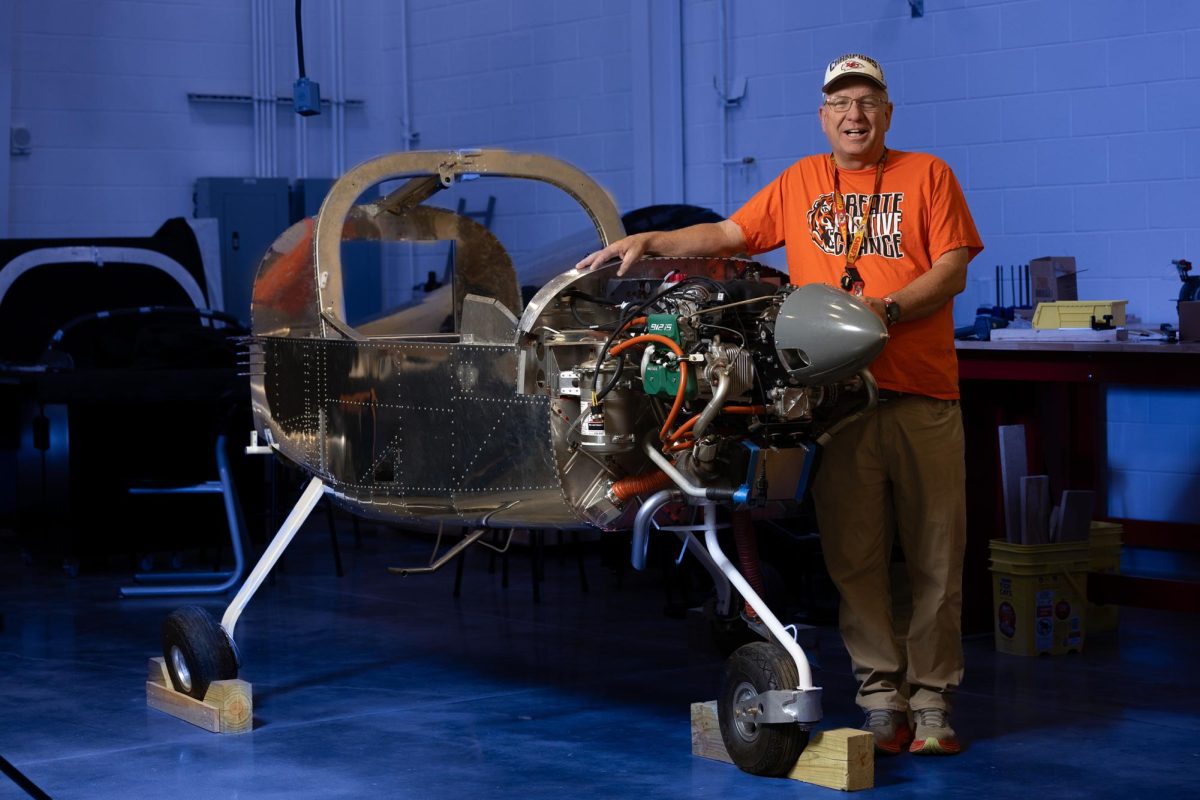
Go home, Don Broyles was told. Two commercial airlines had just hit the twin towers, American Airlines Flight 77 hit the Pentagon, and United Airlines Flight 93 just flew into the ground in a remote Pennsylvania field, which would later be determined was heading to Washington D.C. for a fourth attack.
From Shaw Air Force Base in Sumter, South Carolina, to the Combined Air Operations Center in Saudi Arabia, within a week, Broyles was preparing for Operation Enduring Freedom as an Air Force Navigator.
After receiving his commission, Don Broyles wanted to be a pilot, but failed to earn his pilot wings along with 50% of the other trainees. To Broyles’ gratitude, his scores were high enough to go to navigator school in Sacramento, California, for training in the B-52 Stratofortress.
From there, Broyles was stationed in Minot, North Dakota, for three years, Fort Sumpter, South Carolina, for two years, and later Barksdale Air Force Base in Shreveport, Louisiana.
Twenty-seven days after the terrorist attack on the World Trade Center and the Pentagon, the President ordered bombers to employ weapons against the Taliban and other terrorist groups in Afghanistan. Broyles had faced enemies like this before, in Black Ops Mission: Secret Squirrel, a classified mission during the 1991 Gulf War over the skies of Iraq.
During the Secret Squirrel mission, Broyles navigated a 35-hour flight from Barksdale Air Force Base in Louisiana to the border of Iraq, where his aircrew and other aircraft employed the first-ever conventional air-launched cruise missiles.
“If anybody else saw them, they would have thought they were nuclear weapons,” Broyles said. “Nobody knew we had changed them over to conventional…The plane I was on, and six others, went over there. We were the very first planes to take off for the war.”
During their mission, they used over a million pounds of fuel, flying to Iraq, launching over 35 cruise missiles, and flying back to Barksdale AFB. For seven days straight, the bomber aircrews stayed on high nuclear alert after their mission.
“In case Russia did something,” Broyles said. “We could respond, then I got sent to Moron, Spain, and I flew eight more missions out of Moron into Iraq.”
In eight sorties over Iraq, Broyles navigated the B-52 bomber that delivered over 325,000 pounds of bombs. On a particular night, his aircrew flew over downtown Baghdad while bombing a target, and unexpectedly, the enemy fired back.
“We inadvertently had a light [navigation light turned] on our plane, so they were firing at us the whole time,” Broyles said. “Shells were coming up. Luckily, we were too high, so they missed. It was awaking, knowing I could not be here today because of one little mistake.”
Broyles also flew low-level missions, one of which he could feel the “pitter-patter” of percussion from the bombs underneath their feet on the plane. They often practiced this technique with Air Penetration exercises over Canada, flying as low as 50 feet above the ground at 360 miles per hour.
Broyles recalls waiting to take out two Surface-to-Air Missile sites in Operation Desert Storm. Iraqi troops and Al Qaeda agents placed the missile installations close to civilian sites, making it hard for Broyles and his team to destroy them without harming civilians.
“We couldn’t do anything,” Broyles said. “We would wait. Finally, they moved it to where they weren’t supposed to, and then we got it. We’re probably one of the few countries that really worry about trying to protect civilians and buildings.”
At the end of his 20 years of service for the United States Air Force, Broyles retired. After missing the first day of school, holidays and other occasions with his kids while overseas, Broyles wanted to settle down and be with his family more than ever.
“I wanted to be somewhere when my kids were in school, I was in school. When my kids were off, I was off,” Broyles said. “I fell in love with it… both my kids graduated from the high school I taught at.”
Eventually, Broyles wanted to teach more than just math. Since his kids had graduated, he pursued other endeavors, which led him to Texas High School, where he now teaches aviation and computer science.
“I love it when I see the kids [get it],” Broyles said. “I’ve seen kids out in town, and [say], ‘hey, Mr. Broyles, thanks’ for telling me this or that, or you were right about this. I ultimately want to make an impact on the students who are here and hopefully make their lives better.”

Vietnam was a bloody war, and Carl A. Bandy saw it all. The drafting process was scary enough; after watching the movie M*A*S*H, which was based on life with a mobile Army hospital in the Korean War with his friends, Bandy knew it wasn’t an inviting war.
Before joining the Army, Bandy worked in a cardiac catheter lab where he measured how the heart recovered after heart attacks. While stationed in Houston, Texas, Bandy met Colonel Gregorads, the commanding officer of his unit. Gregorads ensured that everyone in his unit knew of Bandy’s knowledge and experience before Bandy arrived. This expertise enabled Bandy to serve wounded soldiers in hospitals rather than on the front lines of the war.
When Bandy arrived at his unit, everyone had been aware of his presence and acted out of character. This draftee’s reputation preceded him, and it seemed everyone knew his skills before he arrived at his duty station.
Once put in the catheter and electrocardiogram (EKG) lab, he worked on the constant flow of injured soldiers. Despite Bandy’s fear of active duty, they needed him more at the San Antonio hospital, where there was one doctor for every five wounded soldiers. Most serious patients were getting airlifted out of Vietnam and sent directly to the San Antonio hospital.
Bandy saw patients approximately 24 hours after their initial injury that occurred over 9,000 miles away. He often assisted in treatment and monitored soldiers in the lab to help them recover. Others who were less fortunate had to recover for over a year in Okinawa before getting sent to Bandy’s Unit.
Bandy soon taught others how to work in his lab, where his first teaching experience began. There, he met his wife, who was a lieutenant in San Antonio. He continued to teach on-the-job training, and once he and his wife retired from service, Bandy became a salesman for the company that manufactured the cardiac catheter machines, Smith Klein.
“Medical companies were buying each other and absorbing them, and by the time I started my own business, my wife said, ‘Maybe you should get something a little more stable,” Bandy said. “I said I needed to get some initials…I got a daughter in medical school [M.D.], I got a son in law school [Esq.]…if I can get some initials, I’ll become a teacher.”
Bandy’s father was a teacher, which made Bandy initially not want that either, but he eventually “acquiesced” and enrolled in a program to earn his master’s in education. With a master’s degree, experience in cardiology, and a seat on multiple hospital and cardiology boards, Bandy taught various subjects: biology, chemistry, physics, anatomy, and physiology.
Bandy now teaches anatomy and physiology at Texas High School, where he educates and observes his students with passion.
“I wish we were like the Israelis, where all young men and women of a certain age would go into the military,” Bandy said. “Something as simple as the pledge of allegiance, I stand and salute and take my moment of silence,… and the kids are talking and nobody stands. It’s almost as though they don’t value what we —and those before me and after me —are doing for this country. They think they’re cool…but our country is getting weaker, so that is what I wish.”
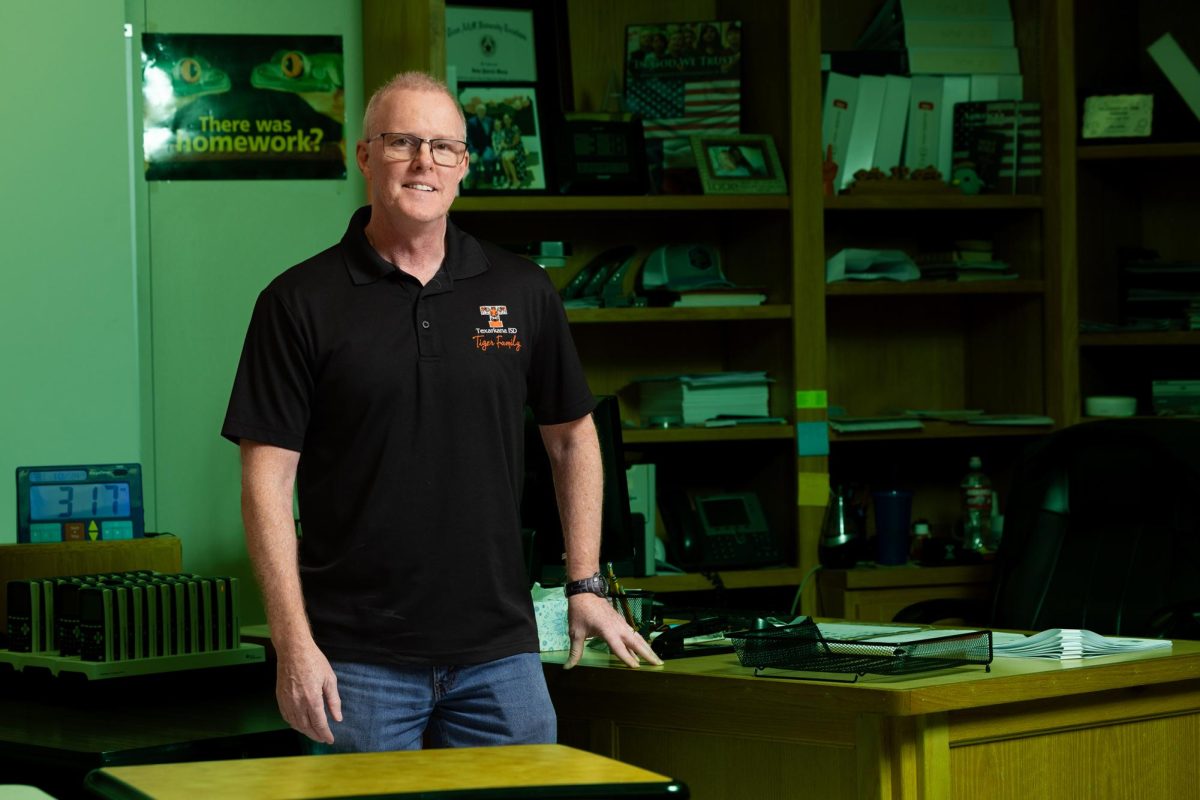
The beeping of the V in Morse code warns receptor J.P. Welsh that enemy communicators are about to start typing. After training for this in Fort Dix, New Jersey, Welsh was ready. While in training, Welsh practiced with 20 words a minute to pass, but in the field, he experienced 30-40 words a minute communicators that Welsh intercepted and wrote down on a typewriter.
As a 19-year-old from Mississippi who graduated in Miami, Florida, Welsh had top-level military clearance and spied on enemy communication lines.
Welsh recalls the scariest moment in his 4-year career as an Army soldier was when a South Korean Airliner got shot down “by accident”. Welsh worried about deployment to front-line duty despite being stationed in Germany for only 2 weeks.
His base practiced monthly alert drills. In routine cases, it occurred around 4:30 in the morning; however, in this instance, Welsh was alerted during a movie screening on base late at night.
Welsh’s friend, Leroy, reassured him after his concern and confusion about what the alert was actually for, telling Welsh that if it was a real alert, they would have him “at the motor pool bleeding the brakes on the vehicles, getting them ready to move out.”
Just then, a knock on the door alerts Leroy that he needs to get to the motor pool to start bleeding the brakes, and that everyone needs to report to their posts and get ready to load and head out.
“It put the fear of God in our hearts,” Welsh said. “All I can think is Mom, what did I get into.”
However, nothing came of the alert, and at the end of Welsh’s four-year service, he went to college, taking a few classes at a time. Though it was slow, he began to see signs of his true calling after many years as an accountant, leading him to pursue education.
“God plain and simple, God,” Welsh said. “Pastor John [Miller] preached a message on a Sunday Morning at Church on the Rock, and I just felt like God was telling me that there are kids in this school that need an adult Christian male role model.”
Welsh thought back to his numerous encounters in college with people asking if “he’d ever thought about being a math teacher”. Now it all makes sense. This is what he had been called to do, and he wasn’t going to let his students down.
Welsh now encourages students in their walk of life to be their best selves; always pursuing to be the role model God called them to be.
“I tell a lot of my students, and this was the Army’s theme, a great place to start,” Welch said in his math classroom. “Fresh out of high school, you don’t know what you’re doing… You can get a job in the army, learn a skill… maybe make it a career, you can learn valuable life skills.”

Yolanda George knew her parents couldn’t afford to put her through college as she had hoped; her next best option was the military. She had family members in the military, so George knew this was an opportunity to get her education and serve her country.
After basic training, George began medical training at Fort Sam Houston Army Base in San Antonio, Texas as an Army field medic in the Army Reserve. There, she practiced fieldwork and provided care for her comrades. George practiced at a field hospital, placing IVs, taking blood pressure and supporting patients.
Upon completing a year in the Army Reserves, George swapped branches and became an active-duty Air Force airman working in base supply. From there, she provided supplies to anyone on base for any reason; she ran a tight ship to keep everything orderly. George handled everything from paper clips to couches, working behind the scenes when no one else was looking.
George served at military installations from San Antonio, Texas, to Germany. In those seven years, she learned military standards and how she would later teach her future students.
“If you’re early, you’re on time; if you’re on time, you’re late,” George said, sitting in her classroom. “I don’t like tardiness. My kids will tell you, I give them tardies. If you’re late, you’re late, because you can’t always be late on your job.”
George was amazed by all the people from “different walks of life” that worked together efficiently and with initiative, always to get the job done. They gave her a family she never expected.
After growing up in Pittsburg, Texas, George is back in her home state of Texas, teaching Food Science and Biology at Texas High. George provides students with the knowledge to succeed and prepare for their exit from Texas High School.
“I think teaching was always what I wanted to do,” George said. “I just couldn’t afford to get there, so I took a roundabout way to get there. Now I don’t know if I would change anything about it. I think being in the military helped me a lot.”

Jeff Crowson was not the most responsible man before he enlisted in the United States Air Force. Once through basic training, that characteristic changed; he became the historian at the Wing he was assigned to, and kept a record of what that Wing did during the year. Crowson’s recorded history of the Wing’s activities for a year was usually around 350 pounds, and, when stacked, would be four to five feet tall when finished.
Crowson is a 1991 Gulf War vet and, outside of his historian duties, was stationed at Hellinikon Air Base in Athens, Greece, working on classified information in support of Operation Desert Shield and Desert Storm.
After Crowson’s service in the United States Air Force, he became a law enforcement officer and has taught criminal justice classes at Texas High School.
“I would teach during the day and do police work at night,” Crowson said. “I really enjoyed the teaching side of those jobs. At the time, my wife had just finished her Master’s Degree, and I [thought], I can do that too.”
Once Crowson completed his master’s degree in criminal justice, he accepted a job as a school resource officer at Redwater ISD, where he also taught dual credit classes.
“A few years later, I had the opportunity to return to Texas High, and I happily took it,” Crowson said. “Truthfully, I love to tell stories. While teaching criminal justice classes, I was able to do that during the lectures, and the students really seemed to enjoy my classes. For me, teaching has been a very rewarding 15 years.”

After working three years in the Elevator Union as an apprentice in Denver, Colorado, Dustin Andrews knew he needed to face something different. His stepdad had been in the military, and Andrews understood this could be his chance.
Andrews enlisted as an Army Infantryman in January 2013. After completing basic training, he served at Fort Campbell, Kentucky, for the duration of his military service. There, Andrews practiced shooting and field work on base and in the area.
Andrew’s service ended in February of 2015; from there, he left and built a life on a homestead, later training to join the police academy.
“It’s a paramilitary, so being a police officer is so much easier than being in the military,” Andrews said. “You’ve got to memorize things like criminal procedure, penal code, juvenile code, and other bookwork.”
Once preparing to protect this country, Andrews now guards Texas High School as a Police Officer. Assisting in safety, traffic and other duties, Andrews keeps Texas High School safe.
Holley Robinson • Nov 11, 2025 at 9:13 pm
I love the details of this article. Thank you for writing about our veterans. You are an excellent writer.